📘 Longman - Preparation Course For TOEFL Test
📘 Progress
15 / 58
- Grammar
- Skill 1 Be Sure The Sentence Has A Subject And A verb
- Skill 2 Be careful of object of preposition
- Skill 3 Be Careful of Appositives
- Skill 4 Be Careful of Present Participle
- Skill 5 Be Careful of Past Participles
- Sentence With Multiple Clauses
- Skill 6 Use Coordinate Connectors Correctly
- Skill 7 Use Adverb Time and Cause Connectors Correctly
- Skill 8 Use Other Adverb Connectors Correctly
- Skill 9 Use noun clause connector correctly
- Skill 10 Use Noun Clause Connector or Subject Correctly
- Skill 11 Use Adjective Clause Connectors Correctly
- Skill 12 Use Adjective Clause Connector Or Subject Correctly
- Sentence With Reduce Clauses
- Skill 13 Use Reduced Adjective Clause Correctly
- Skill 14 Use Reduced Adverb Clauses Correctly
- Skill 15 Invert The Subject and Verb with Question words
- Skill 16 Invert The Subject and Verb with Place Expression
- Skill 17 Invert The Subject and Verb with Negatives
- Skill 18 Invert The Subject and Verb with Conditionals
- Skill 19 Invert The Subject and Verb with Comparisons
💪Exercise
- Exercise Skill 1
- Exercise Skill 2
- Exercise
- Exercise Skill 4
- Exercise Skill 5
- Exercise 1-5
- Exercise Skill 6
- Exercise Skill 7
- Exercise Skill 8
- Exercise Skill 6 - 8
- Exercise Skill 9
- Exercise Skill 10
- Exercise Skill 11
- Exercise Skill 12
- Exercise Skill 9 - 12
- Exercise Skill 13
- Exercise Skill 14
- Exercise 15
- Exercise 16
- Exercise 17
- Exercise 18
- Exercise 19
💡 Konsep Penting
- Simple Present Tense
- Present Perfect Tense
- frase nomina
- Verb
- noun
- Subject
- preposition
- Appositive
- Adjective
- Adverb
- Past Participles
- Noun Clause
- Sentence With Reduce Clauses
🔍 Ringkasan
Skill 2
Be careful of object of preposition
An object of a preposition is a noun, pronoun, gerund or noun clause ( read this : Subject) that comes after a preposition, such as in, at, of, to, by, behind, on, and so on, to form a prepositional phrase.
(After his exams) Tom will take a trip (by boat).
This sentence contains two objects of prepositions. Exams is the object of the preposition after, and boat is the object of the preposition by. An object of a preposition can cause confusion in structure questions on the TOEFL test because it can be mistaken for the subject of a sentence.
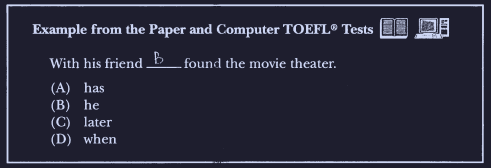
In this example you should look first for the subject and the verb. You should notice the verb found and should also notice that there is no subject. Do not think that friend is the subject; friend is the object of the preposition with, and one noun cannot be both a subject
and an object at the same time. Because a subject is needed in this sentence, answer (B), he, is the best answer. Answers (A), (C), and (D) are not correct because they cannot be subjects

Skill 3
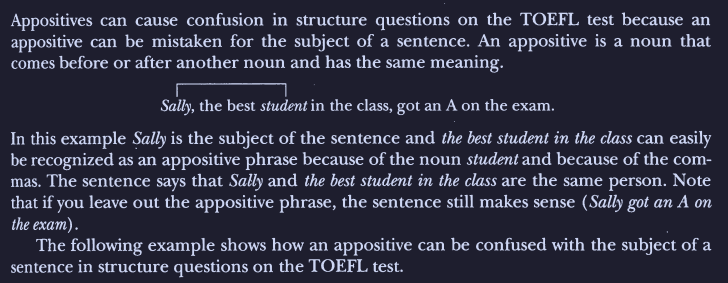
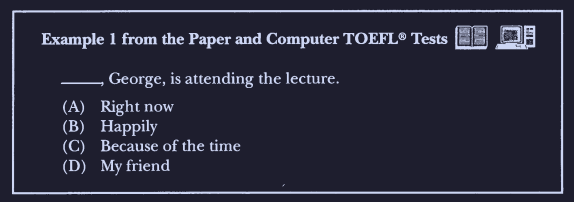
In this example you should recognize from the commas that George, is not the subject of the sentence. George, is an Appositive. Because this sentence still needs a subject, the best answer is (D), my.friend. Answers (A), (B), and (C) are incorrect because they are not subjects. The next example shows that an appositive does not always come after the subject; an appositive can also come at the beginning of the sentence.
Skill 4
Be Careful of Present Participle
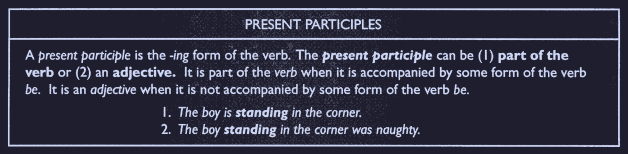
A present participle is the -ing form of the verb (talking, playing). In structure questions on the TOEFL test, a present participle can cause confusion because it can be either a part of the verb or an Adjective. It is part of the verb when it is preceded by some form of the verb be.
VERB
In this sentence talking is part of the verb because it is accompanied by is. A present participle is an adjective when it is not accompanied by some form of the verb be.

In this sentence talking is an adjective and not part of the verb because it is not accompanied by some form of be. The verb in this sentence is has. The following example shows how a present participle can be confused with the verb in structure questions on the TOEFL test.
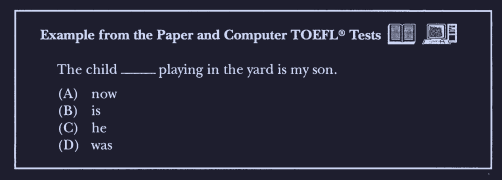
In this example, if you look at only the first words of the sentence, it appears that child is the subject and playing is part of the verb. If you think that playing is part of the verb, you might choose answer (B), is, or answer (D), was, to complete the verb. However, these two answers are incorrect because playing is not part of the verb. You should recognize that playing is a participial adjective rather than a verb because there is another verb in the sentence is. In this sentence there is a complete subject child and a complete verb is, so this sentence does not need another subject or verb. The best answer here is (A).
The following chart outlines what you should remember about present participles:
Skill 5
Be Careful of Past Participles
Past Participles verb III of a verb, such and was) as studied, taught, cooked and many others. Past participles can cause confusion in structure questions on the TOEFL test because a past participle can be either an adjective or a part of a verb.
- In the first sentence the past participle purchased is part of the verb because it is accompanied by has.
- In the second sentence the past participle written is part of the verb because it is accompanied by was.
2. As an Adjective Past participle functions as an adjective if it is not accompanied by have, has, had and to be. Example:
The television purchased (Adj) yesterday was expensive. The poem written (Adj) by Paul appeared in the magazine.
- In the first sentence purchased is an adjective rather than a verb because it is not accompanied by a form of be or have (and there is a verb, was, later in the sentence).
- In the second sentence written is an adjective rather than a verb because it is not accompanied by a form of be or have (and there is a verb, appeared, later in the sentence).
Skill 6
Use Coordinate Connectors Correctly
When you have two clauses in an English sentences, you must connect the two sentences correctly. One way to connect two clauses is to use AND, BUT, OR, SO, or YET between the clauses.
Look at the following sentences:
- Tom is singing, and Paul is dancing.
- Tom is tall, but Paul is short.
- Tom must write the letters, or Paul will do it.
- Tom told a joke, so Paul laughed
- Tom is tired, yet he is not going to sleep.
In each of these sentences, there are two clauses that are correctly joined with a coordinate conjunction AND, BUT, OR, SO or YET, and a comma (,).
Skill 7
Use Adverb Time and Cause Connectors Correctly
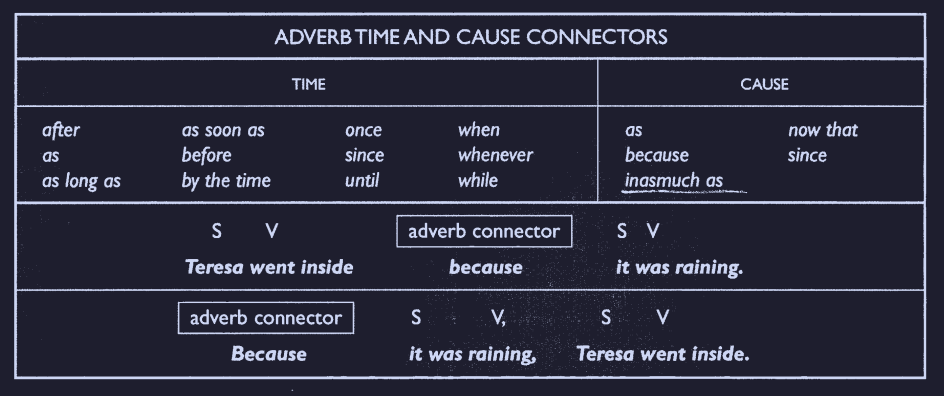
Sentences with adverb clauses have two basic patterns in English. Study the clauses and connector in the following sentences.
I will sign the check before, you leave Before you leave, I will sign the check.
In each of these examples, there are two clauses you leave and I will sign the check, and the clause you leave is an adverb time clause because it is introduced with the connector before.
In the first example, the connector before comes in the middle of the sentence, and no comma (,) is used.
In the second example, the connector before comes at the beginning of the sentence. In this pattern, when the connector comes at the beginning of the sentences, a comma (,) is required in the middle of the sentence.
Skill 8
Use Other Adverb Connectors Correctly Adverb Clauses can express the ideas of time and cause, as you read in skill 7. Adverb clause can also express a number of other ideas, such as contrast, condition, manner and place. Because these clauses are adverb clauses, they have the same structure as the time and cause clauses in Skill 7. Study the following sentences.
I will leave at 7:00 if I am ready Although I was late, I managed to catch the train
In each of theses examples, there are two clauses that are correctly joined with adverb connectors. In the first sentence, the adverb condition connector if comes in the middle of these sentences. In the second sentence, the adverb contrast connector although comes at the beginning of the sentence, and a comma (,) is used in the middle of the sentence.
The following example shows a way that this sentence pattern can be tested in the structure section of the TOEFL Test. Example:
You will get a good grade on the exam provided… (A) studying (B) study (C) to study (D) you study
In this example, you should quickly notice the adverb condition connector provided. This connector comes in the middle of the sentence; because it is a connector, it must be followed by a subject and a verb.The best answer to this question is answer (D), which contains the subject and verb you study.
The following chart lists adverb contrast, condition, manner and place connector and the sentence patterns used with them.

Skill 9
Use noun clause connector correctly
A noun clause is a clause that functions as a noun. Because the noun clause is a noun, it is used in a sentence as either an object of a verb; an object of preposition, or the subject of the sentence.

In the example above, there two clauses, I know and he will come. This clause is joined by a connector WHEN. WHEN changes the clause he will arrive into a noun clause that functions as the object of the verb KNOW.

In the example above, there two clauses, I am concerned and he will arrive. This clause is joined by a connector WHEN. WHEN changes the clause he will arrive into a noun clause that functions as the object of the preposition ABOUT.

In the example above, It is more difficult. There are two clauses, but they area a little harder to recognize. He will arrive is is one of the clauses, and the connector WHEN changes into a noun clause that functions as the subjects of the sentence. The other clause has the main clause WHEN HE WILL ARRIVE as its subject and is as its v_erb_.
Example:
___________ was late caused many problems
A. That he
B. The driver
C. There
D. Because
Answer (A)
In this example, there are two verbs (was and caused) and each verb needs SUBJECT. The best answer is (A). That is the SUBJECT of CAUSED and HE is SUBJECT of WAS.
So, the complete sentence is THAT HE WAS LATE CAUSED MANY PROBLEMS
Skill 10
Use Noun Clause Connector or Subject Correctly
In skill 9, Noun Clause connectors were used to introduce noun subject clauses or noun object clauses.
In this 10, a noun clause connector is not only a connector; a noun clause connector cam also be the subject of the clause at the same time.

In the first example, there two clauses; I do not know and what is in the box. These two sentences are connected by the connector what.
In the second example, there two clauses, in the first clause we is the subject of are. In the second clause who is the subject of will. Who also serves as the connector that join the two clauses.The noun clause who will do the work function as the object of preposition about.
In the last example,there are two clauses, whoever is the subject of the verb is coming and the noun clause whoever is coming to the party is the subject of must bring. The word whoever serves two function in the sentences; the subject of the verb is coming and the connector that joins the two clauses.
Example:
__________ was on television made me angry.
A. It
B. The story
C. What
D. When
In the example above, there two VERBS, was and made. Each of those verbs needs a Subject . Best Answer is C (What). What is the subject of verb was and the verb made. What also serves as the connector that connect the two clauses together.
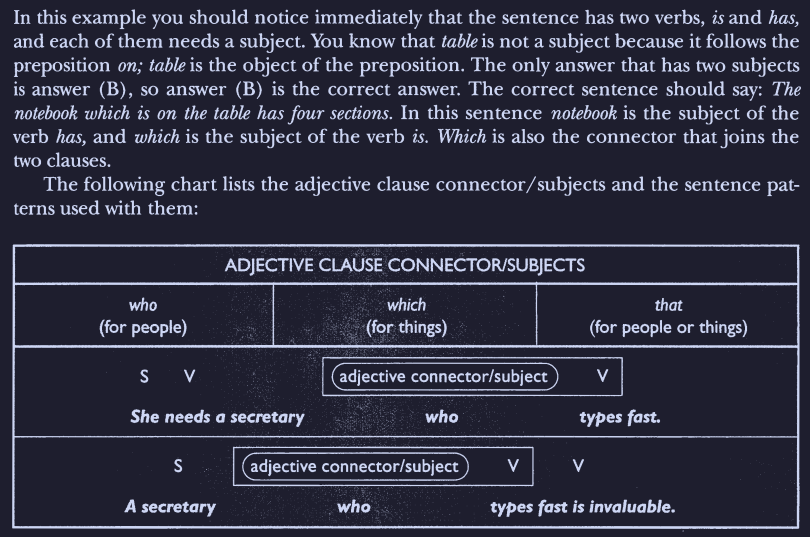
Skill 11
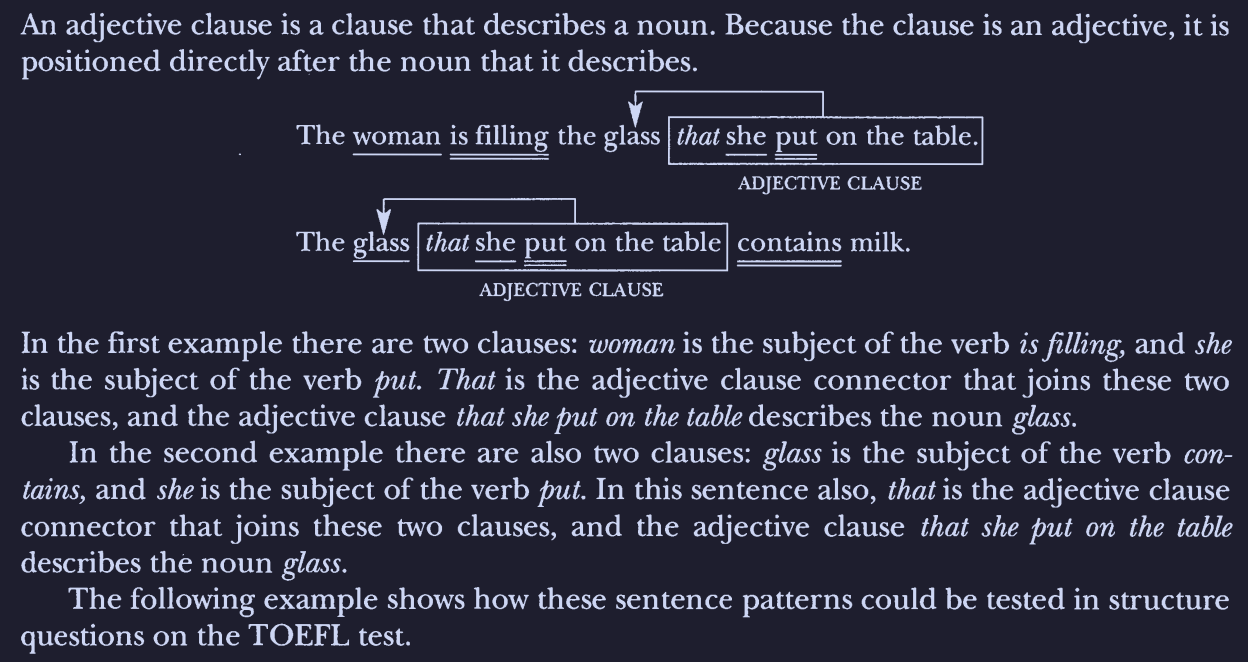
Use Adjective Clause Connectors Correctly
Skill 12
Use Adjective Clause Connector Or Subject Correctly
Skill 13
Use Reduced Adjective Clause Correctly Adjective clauses can appear in a reduced form. In the reduced form, the adjective clause connector and the be-verb that directly follow it are omitted.
The woman who is waving to us is the tour guide.
⇒ The woman waving to us is the tour guide. (omit “who is”)
The letter which was written last week arrived today. (omit “which was”)
⇒ The letter written last week arrived today. (omit “which was”)
The pitcher on the table is full of iced tea. (omit “that is”)
⇒ The pitcher that is on the table is full of iced tea. (omit “that is”)
Each of these sentences may be used in the complete form or in the reduced form. In the reduced form the connector “who, which, or that” is omitted along with the be-verb “is” or “was”. If there is no be-verb in the adjective clause, it is still possible to have a reduced form. When there is no be-verb in the adjective clause, the connector is omitted and the verb is changed into the -ing form.
- I don ‘t understand the article which appears in today’s paper.
⇒ I don ‘t understand the article appearing in today’s paper. (omit “which”, then change the verb into the -ing form)
In this example there is no be-verb in the adjective clause which appears in today’s paper, so the connector “which” is omitted and the main verb “appears” is changed to the -ing form “appearing”.
It should be noted that not all adjective clauses can appear in a reduced form. An adjective clause can appear in a reduced form only if the adjective clause connector is followed directly by a verb. In other words, an adjective clause can only be reduced if the connector is also a subject.
The woman that I just met is the tour guide. (does not reduce)
The letter which You sent me arrived yesterday. (does not reduce)
In these two examples the adjective clauses cannot be reduced because the adjective clause connectors “that and which” are not directly followed by verbs; “that” is directly followed by the subject “I”, and “which” is directly followed by the subject “you”.
A final point to note is that some adjective clauses are set off from the rest of the sentence with commas, and these adjective clauses can also be reduced. In addition, when an adjective clause is set off with commas, the reduced adjective clause can appear at the front of the sentence.
The White House, which is located in Washington, is the home of the president.
The White House, located in Washington, is the home of the president.
Located in Washington, the White House is the home of the president.
The president, who is now Preparing to give a speech, is meeting with his advisors.
The president, now preparing to give a speech, is meeting with his advisors.
Now preparing to give a speech, the president is meeting with his advisors.
In these two examples, the adjective clauses are set off from the rest of the sentence with commas, so each sentence can be structured in three different ways: (1) with the complete clause, (2) with the reduced clause following the noun that it describes, and (3) with the reduced clause at the beginning of the sentence.
Example:
_____ on several different television programs, the witness gave conflicting accounts of what had happened.
(A) He appeared
(B) Who appeared
(C) Appearing
(D) Appears
In this example, answer (A) is incorrect because there are two clauses, “He appeared… and the witness gave…”, and there is no connector to join them. Answer (B) is incorrect because an adjective clause such as “who appeared…” cannot appear at the beginning of a sentence (unless it is in a reduced form). Answer (C) is the correct answer because it is the reduced form of the clause “who appeared”, and this reduced form can appear at the front of the sentence. Answer (D) is not the reduced form of a verb; it is merely a verb in the present tense; a verb such as “appears” needs a subject and a connector to be correct.
Skill 14
Use Reduced Adverb Clauses Correctly
Tentu. Skill 14 ini mirip dengan Skill 13, tujuannya sama-sama mempersingkat kalimat. Bedanya, ini untuk adverb clause (klausa keterangan waktu, alasan, kontras, dll). Berikut adalah poin-poin sederhananya berdasarkan materi buku Anda.
Poin 1: Syarat Utama (Wajib!)
Anda hanya bisa menyingkat (reduce) adverb clause jika Subjek di klausa itu SAMA dengan Subjek di kalimat utama.
- Contoh:
When **you** are ready, **you** can begin your speech.- Subjeknya sama-sama
you, jadi ini BISA disingkat.
- Subjeknya sama-sama
Poin 2: Konektornya TETAP ADA
Ini perbedaan besar dari Skill 13. Konektor seperti Although, When, While, If, After, Before TIDAK DIHAPUS.
Poin 3: Aturan Singkat #1 (Jika ada ‘be-verb’)
Jika di dalam klausa ada be-verb (seperti is, are, was, were):
- Cara: Buang Subjek + Buang
be-verbnya.- Contoh:
- Lengkap:
Although **he is** rather unwell, the speaker will take part... - Singkat:
Although rather unwell, the speaker will take part...
- Contoh:
- Lengkap:
When **you are** ready, you can begin your speech. - Singkat:
When ready, you can begin your speech.
- Lengkap:
Poin 4: Aturan Singkat #2 (Jika TIDAK ada ‘be-verb’)
Jika di dalam klausa adanya kata kerja biasa (seperti feels, give, studies):
- Cara: Buang Subjek + Ubah kata kerjanya ke bentuk -ING.
- Contoh:
- Lengkap:
Although **he feels** rather sick, the speaker will take part... - Singkat:
Although **feeling** rather sick, the speaker will take part...
- Lengkap:
- Contoh:
- Lengkap:
When **you give** your speech, you should speak loudly... - Singkat:
When **giving** your speech, you should speak loudly...
- Lengkap:
Poin 5: Aturan Khusus (Pasif & Pengecualian)
Ini adalah jebakan utamanya.
- Jika Pasif: Kalimat pasif (seperti
it is submitted) mengikuti Aturan #1 (buang subjek + buang ‘be-verb’).- Lengkap:
Once **it is** submitted, your thesis will be reviewed. - Singkat:
Once **submitted**, your thesis will be reviewed. - Contoh soal di buku Anda (
When ____, you are free to leave) juga pasif:When **(you are) finished**...
- Lengkap:
- Pengecualian: Beberapa konektor (seperti
once,if,until) hanya bisa disingkat jika kalimatnya pasif (sepertiOnce submitted...). Mereka tidak bisa disingkat jika kalimatnya aktif.Once **you submit**...(Aktif) → TIDAK BISA disingkat menjadiOnce submitting...❌Once **it is** submitted...(Pasif) → BISA disingkat menjadiOnce submitted...✔️
Skill 15
Invert The Subject and Verb with Question words
⌛Created 2025-10-18 18:24